
Let’s get into the nuance
Anthropic’s draft federal bill leaked to Politico last week and since then has gotten a lot of flak—most of it fair. But rather than regurgitating the bad things about the bill as highlighted Twitter (okay, just a little: requiring the government to prove risk of 50+ deaths or $1b in damage to block a model is pretty nuts), I’m going to focus on flagging some other things about the bill: what’s good, what’s weird, and what’s missing.
What’s good.
Decent updates to transparency rules. Currently, the main “AI laws” we have are just a few state laws that essentially require AI companies to create safety frameworks addressing how the companies plan to assess and mitigate risks like cyber, bio, and loss of control. Then, come model release time, companies are supposed to publish safety reports that show how the company complied with their own self-published safety frameworks. (This is why it’s commonly said that the AI companies are writing their own rules and grading their own homework). Additionally, when there is a “critical safety incident,” the companies are supposed to report it to the state. And yes, yes—I know I’m boiling complex laws (CA’s SB 53, NY’s RAISE Act, and IL’s SB 315) down into very simple terms.
Upsettingly though, SB 53 (the only law in effect at the time) didn’t even really cover the Hugging Face incident. Jonathan Snow, the deputy director for the Homeland Security Division of the Governor’s Office of Emergency Services, said that the OpenAI hack “did not meet the threshold” for reporting under SB 53. Simply put, nobody was hurt, no weights were stolen, it wasn’t catastrophic, and the whole thing basically occurred “in the context of an evaluation.” See SB 53, describing a “critical safety incident.”
It seems, however, that Anthropic’s bill was designed to cover incidents like the Hugging Face hack. Section 3(5) of the draft bill adds a new category—a “containment failure incident”—where “a frontier model, other than as specifically directed or intended by a person or in the intended scope of an evaluation designed to elicit this behavior, circumvents, defeats, or evades a technical or administrative control implemented by the frontier developer to contain or restrict the model, and thereby gains unauthorized access to a computer, information system, or information thereon not under the control of the frontier developer.” Less good: I don’t love some of the thresholds Anthropic adds to the reporting requirements, like the requirement that outside losses be reasonably expected to exceed $250K (Section 7(c)). Yes, under Section 7(e) they still go into an annual count to USG, but I don't understand why the reports can't happen more quickly. They can't be that hard. Just do it.
But back to the good stuff: the bill also requires AI developers to identify which specific models trigger the reporting requirement and brings down the FLOPs threshold to 10^25 FLOPs (versus 10^26 in state laws). Right now, the state laws don’t require AI developers to identify which models hit the compute size thresholds—meaning, when a model is released without a safety report, one of two things is true: either the model is below the size threshold, OR the company is breaking the law. But we have no idea from the outside which is the case. It’s a loophole in the law, and Anthropic’s bill closes it. Also, the lower size threshold is smart. Smaller models are becoming enormously powerful and capable, and they should really be swept up by the law. With algorithmic advancements too, we could see more and more smaller models.
Eh, and because I can’t help adding some criticism even into the good stuff, I’ll just point out that the Anthropic bill does something weird by dropping from the safety frameworks any evaluation about chemical, radiological and nuclear weapons risks. Particularly for chemical… I just don’t get why they’d drop that. What gives? Oops. Okay, back to the good stuff—I promise.
Risk reports. Anthropic already publishes these reports, but the bill would make it so every frontier AI developer has to publish similar risk reports at least every 180 days. See Section 6. Overall, it seems good to make the AI developers routinely assess major risks posed by the frontier models, assessing the risks as they evolve.
Strong whistleblower protections. The Anthropic bill provides stronger whistleblower protections than the state laws—and explicitly *doesn’t* preempt state laws to the extent they provide other protections. Specifically, the draft bill: covers current and former employees, plus contractors of developers and evaluators; protects disclosures to agencies, Congress, and/or supervisors; creates an anonymous channel with monthly updates, with quarterly board reporting in response to those anonymous reports(!); voids gag clauses and forced arbitration(!); and whistleblowers can file with the Department of Labor, then get a federal jury trial after 180 days (that’s a solid timeline & consistent with Sarbanes-Oxley). Plus, remedies include reinstatement, 2× back pay(!) and fees. This all seems solid.
Evaluators. Similar to the Illinois law, Ant’s bill requires that AI companies be reviewed by qualified independent evaluators. But while the Illinois auditors perform their audit every year, the Ant bill makes it every 180 days (6 months) and gives the evaluators “access to information reasonably comparable to the access of the large frontier developer’s internal risk assessment teams.” The Ant bill also goes further, giving evaluators more of a mandate to assess the risks of a model including by taking into account model capabilities, safeguards, and “any increased difficulty of monitoring, assessing, or mitigating enumerated risk that results from the models’ ability to manipulate and evade monitoring, and including risks that automated research and development could shortly increase the level of risk[.]” Section 8(e)(2) (Emphasis added.). Section 8(e) also provides that the evaluators can give “commentary on the developer’s most recently published risk report” and can provide any “corrective actions” they’d recommend. Moreover, while in Illinois the AI company itself publishes a summary and a redacted copy of the audit and decides what counts as ‘appropriate redactions,’ under Anthropic’s bill, the evaluator publishes, and the company can only redact narrow categories and has to give a written reason, with the evaluator getting to say publicly if they disagree. I personally prefer the latter.
Now, people have pointed out that for maximum independence, a licensing regime and more of a structure around evaluators is important. I agree—and maybe that’s part of the long game. Meaning, definitely write that into the statute as a long term goal. But don’t delay getting evaluators in there now, ASAP. A licensing regime just takes time to establish. For example, another rival federal bill, the FRONTIER Act, starts the clock for an evaluator’s review one year after the first evaluator is licensed, which realistically means two years or more. Under Anthropic’s bill, evaluators must be hired within 270 days—which is still a long time, and should be shortened. But alas…
And the concerns about the evaluator’s independence from the AI companies are valid. But the Ant bill does give some public oversight to the GAO. The Government Accountability Office is separate from the executive branch, and it will report to Congress every year on whether the evaluators are independent from the industry, whether there are enough of them, and how to strengthen them. GAO generally publishes its reports, so this gives us, the public, a major way to verify that the evaluators are doing their jobs well. At least until a licensing regime can really take over.
State preemption. The state preemption provisions in Anthropic’s draft are actually pretty okay. The bill leaves untouched most state authority—with broad authority for the state to pass other laws, hold the companies accountable. See Section 14(c)(1)-(5), with only a few “covered functions” actually preempted (Section 14(b)). (Hold on to that phrase, “covered functions”—we’re coming back to that.)
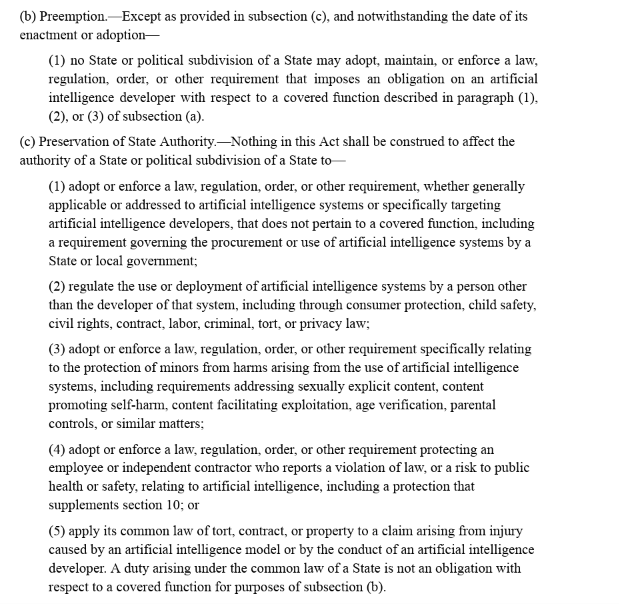
Also, critically, all ambiguities in this preemption provision are construed narrowly and in favor of the states. Plus, the bill explicitly says that compliance with the law gives the AI developers no safe harbor from liability.
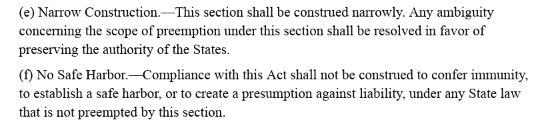
I really like all of that. Also, I feel like no one ever talks about how, even without explicit state preemption, there can be litigated preemption, which would leave us really high & dry. In that sense, it’s also cool that this bill in Section 14(d) expressly rules out field and implied preemption.
What’s weird.
Okay y'all—get ready for this, because it’s really weird. So, above, I mentioned that the bill’s preemption provision only preempts “a covered function described in paragraph (1), (2), or (3) of subsection (a).” That’s pretty darn specific: only three paragraphs of subsection (a) are preempted. Just three paragraphs. So here are paragraphs 1-3:
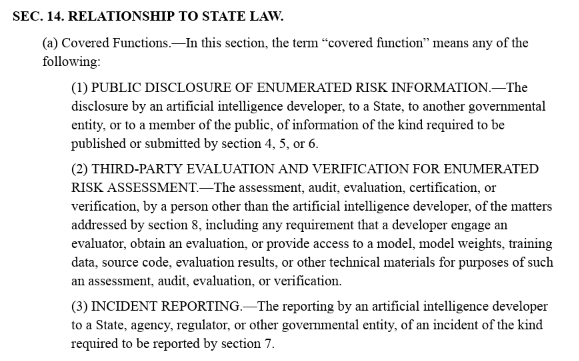
So yeah, the various state transparency laws, i.e., SB 53, RAISE, SB 315, are all preempted. But hey, wait there’s a fourth paragraph under “covered functions”— specifically left out of the preempted things:
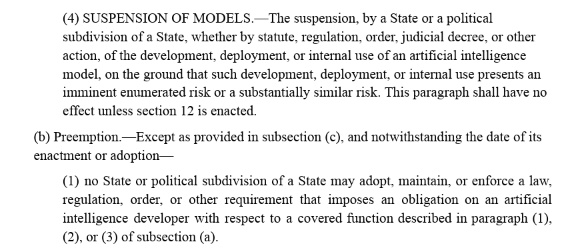
Hold up—did you read that? Do you see what it says? So paragraphs 1-3 of the covered functions are preempted, *but not paragraph 4.* And wait—what about all that great language about how the preemption rules are supposed to be interpreted in favor of the states?? Does this mean…??
Listen. As a former litigator, I’ve always heard the rule of statutory interpretation that courts presume the legislature says what it means and means what it says. If Congress adopted this language, to me, as a lawyer arguing for my hypothetical client in the hypothetical future, I’d be comfortably arguing this bill leaves open the door for the states to suspend models. Maybe I’d lose, but it’s definitely ambiguous—and ambiguity is supposed to be judged in the states’ favor.
And here’s another weird thing: Section 14(h) says that, with respect to this section, ‘enumerated risk’ isn’t limited by the 50/$1B thresholds. So, in other words, paragraph 4 is written as covering state suspensions at any scale. Right now, that's a good thing. But if a future draft added paragraph 4 to Section 14(b) (the state preemption provision), states would lose that power at any scale. That's super upsetting.
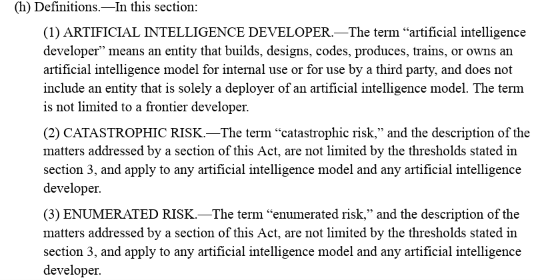
Now, someone will say, "Section 14(a)(4) is plainly written to be preempted—how would someone explain Congress leaving suspension of a model out of state preemption when that paragraph says, ‘no effect unless section 12 is enacted’ clause?” (Section 12 is about the US Government’s ability to block a model – the provision that requires the government prove there’s an imminent risk the model will cause 50+ people dying or $1B in damages before blocking a model.) Maybe. But again, the bill is pretty explicit about avoiding implied preemption. How better to avoid an argument that Section 12 implicitly displaces state suspensions than listing suspension as a covered function, then pointedly leaving it out of §14(b)? Honestly, that would build a strong record that Congress considered state preemption for model blocking and chose not to preempt it.
I really don’t understand what Anthropic was trying to accomplish here. Part of me thinks they are genius for sneaking this in—maybe making the accelerate-people and others think they’d won some big preemption battle. But I feel like people would catch that before the bill was finalized, and then that would be bad. Honestly, I just really don’t know if Anthropic drafted this pretty poorly or if they were just trying to do something too clever by half. Hence “weird.” Really weird… uber bizarre.
What’s missing.
In general, I was kind of disappointed by how uncreative the bill is and how.. rigid. Let me make some suggestions on what’s missing:
Flexible standards. Not everything has to be invented from first principles. The law has many centuries of sorting out what’s right and good and appropriate based on specific facts and circumstances. Indeed, one of the first things we learn about in law school is this concept of a “reasonable person” standard, i.e., what would a reasonable person do under the particular facts and circumstances. There are many good flexible standards like this in the law. Unfortunately, Anthropic’s bill doesn’t have many of them.
Instead, Anthropic lifted the hard numeric catastrophic risk thresholds set in SB 53 and the other state laws and imported them into specific thresholds the US Government needs to prove in order to seek a court order blocking a model when it’s trying to save lives. This is where Anthropic is running into a buzz saw. Those numeric thresholds roughly work for the transparency laws and reporting requirements, but they are overly restrictive and harsh for having the government try to save lives and massive economic damage.
A better approach would be a more flexible standard like the ones we’re familiar with in other laws. Something like, the USG can move for a blocking order if it has “reasonable grounds for concern that there is a risk of significant physical injury or loss of life or substantial damages.” Okay, so I’d want to do some more legal research on those more flexible terms before proposing that exact language—but you get the point. If we just preserve some flexibility in the law to address the specific circumstances before it, we’d have a much easier time addressing the unknowns that we are likely to face.
Burden shifting. My prior is I think at this point the AI companies should basically be required to prove that the models are safe before developing them, using them internally, or releasing them. So yeah, I’d be in favor of an FDA style regime. But if I can’t get that, and if the pro-accelerate crowd really have such influence in Washington, I think a reasonable federal law would involve some sort of “burden-shifting.” Anthropic’s bill right now unfortunately puts way too much burden on the government (note: the 50+ people or $1B in damages comes from how the bill defines “enumerated risk”):
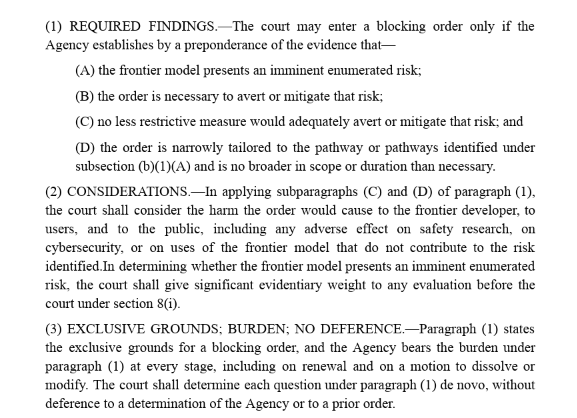
To more reasonably balance the burdens, there are a number of options, for example, requiring that the government make a prima facie showing that it has reasonable grounds for concern that there is a risk of significant physical injury or loss of life or substantial damages (or something like that). But then the burden before the court should be the AI developer’s to prove that the model is safe and substantially unlikely to cause significant physical injury or loss of life or substantial damages. Something like that would go a long way to avoiding the arbitrary/capricious shut down of a model, while preserving the main goal of safety—which should always be the company’s burden.
A neutral arbiter needs real resources. It’s just a little too easy and short-sighted to keep dumping stuff on the courts, which are already overburdened and under-resourced. If we’re serious about having a neutral arbiter decide between the government and the companies whether to release potentially terrifyingly capable models, we need to stock that person or persons with resources and the tools they need to make that decision. What that means: maybe specific judges who have lighter dockets. Maybe more than one judge – like a panel of three. And maybe encourage them to appoint a few outside experts for help evaluating the evidence. See Fed. R. Evid. 706 (allowing judges to appoint an expert for the court’s own use). (Ant's bill says the agency must file an independent evaluator’s assessment (per Section 12(b)(2)), and the court gives it “significant evidentiary weight” (Section 12(c)(2)), so that’s a good foundation, but we could do even more). Overall, we need to make sure our judges can act quickly, have the information they need to really evaluate the danger posed, and ideally aren’t totally by themselves in making these massive decisions potentially for all of humanity.
Conclusion
I have so many more thoughts, but that’s a start for today, if we are going down a road anything like what Anthropic is proposing. My personal solution is really much stricter than this – probably more like an FDA for AI models: nothing gets released until thoroughly tested and approved as safe. But people should start sharing their ideas. Let’s have more conversations about how to really do this.