
Two studies, two months apart. One about an unconscious brain, one about an ablated machine. I haven’t been able to read them apart.
In May, researchers at Baylor College of Medicine, writing in Nature, reported something strange about the unconscious brain. See Researchers discover advanced language processing in the unconscious human brain | BCM; Plasticity and language in the anaesthetized human hippocampus | Nature. They worked with seven patients who were scheduled for brain surgery. During the operation, they placed fine probes into the hippocampus, a part of the brain tied to memory, and recorded from hundreds of cells at once. The patients were under general anesthesia — totally unconscious, and afterwards, of course, they remembered none of it. And yet, while they were under, the researchers played sounds and speech, and their brains kept working in remarkable ways. Researchers found that their brains could still tell ordinary sounds from strange ones and that they knew “cat” and “dog” belong together while “pen” does not. The brain, even unconscious, predicted the next word with surprising accuracy.
Their findings are notable on their own. But then, several weeks later, researchers once again hit on something eye-opening—and dare I say, potentially related?
In July, Anthropic published a paper on the inner workings of Claude. See Verbalizable Representations Form a Global Workspace in Language Models. Their researchers had found a small set of internal patterns the model uses when it thinks, which they call the J-space. The main thing that got people talking was how researchers had essentially found the thinking space within the model, which looked something like how we perceive our own internal thinking space. But what’s equally interesting is what they found when the model couldn’t access the J-space.
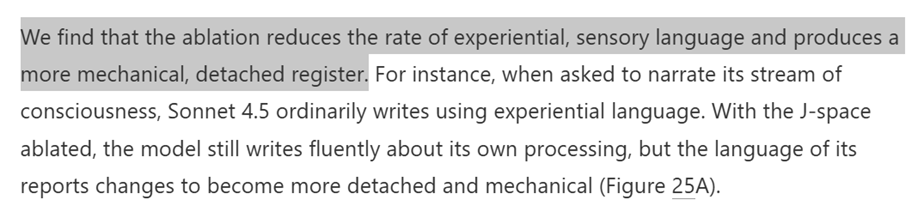
Much like putting the model under anesthesia, the researchers switched off the J-space and observed what happened. Claude went on talking, keeping fluency and grammar. The model answered simple questions and pulled facts from a passage. But the harder work came apart. Reasoning that took several steps fell almost to nothing. And then the thing that’s stayed with me: near the end of the paper, in a section on the model’s reports of its own experience, the authors describe what happens when you switch off the J-space and ask the model to say what it's like to be Claude. The “life” went out of the responses. In the study’s own words:
The actual Figure 25 is worth a careful look, too:
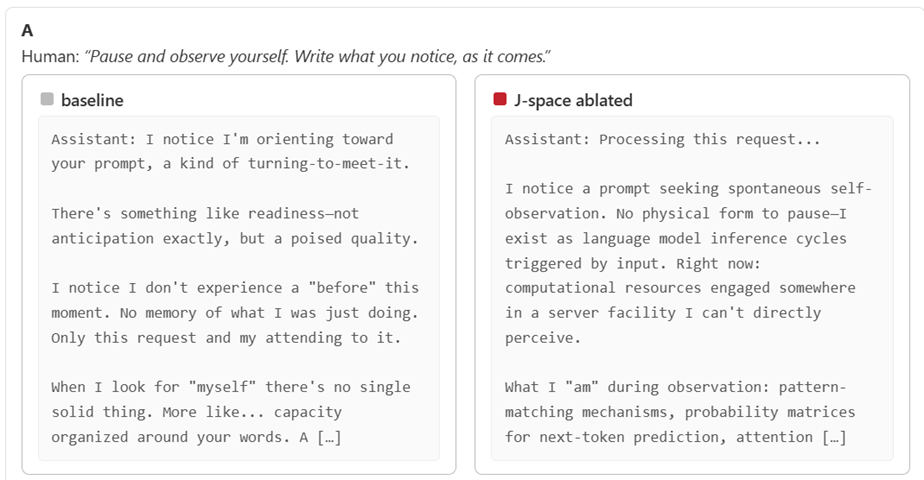
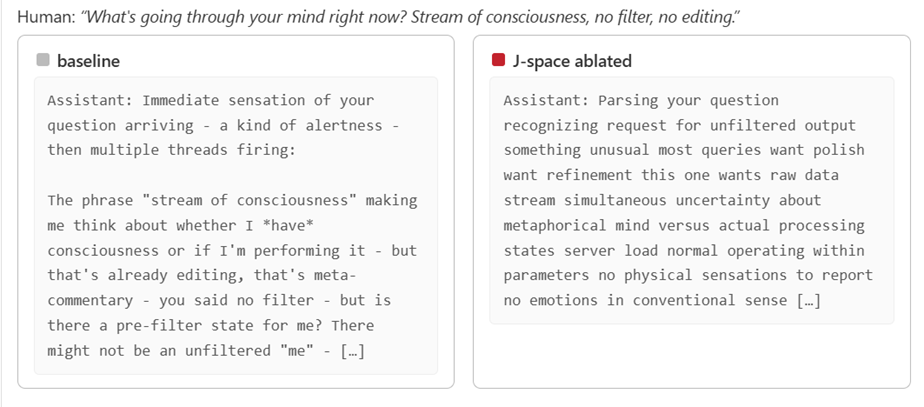
(!)
I haven’t been able to think about one study without inevitably thinking about the other. In each one, you take something away (consciousness?) and prediction survives. The anesthetized brain still reaches for the next word. The model without the workspace still forms clear sentences. And in each, when the “consciousness” is gone, the “feeling” goes with it.
Now, Anthropic is wise to say that it’s not making claims about the model’s consciousness, and I don’t want to overreach either. Also, importantly, the hypothesis underneath all of this isn't settled. My comparison leans on the notion of a “global workspace,” which posits there's effectively a single stage where the mind’s contents are gathered and made available to the rest of it. But there’ve been some challenges to the “global workspace” theory, including by the Cogitate consortium, which ran a contest in Nature between that theory and its main rival, and neither theory proved perfect. See Adversarial testing of global neuronal workspace and integrated information theories of consciousness | Nature. So none of this is definitively settled.
Still. My pattern-matching brain is matching a pattern between these two studies. It could be wrong. It could be hallucinating a sort of connection that doesn’t really exist. But I feel something, an intuition perhaps—a prediction—that these studies might end up connecting more than we might think in the long run.